|
|

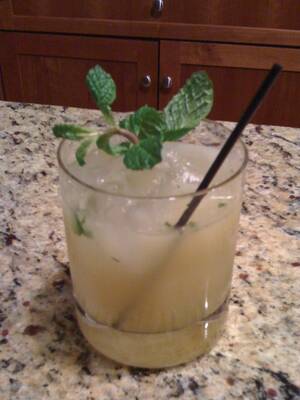
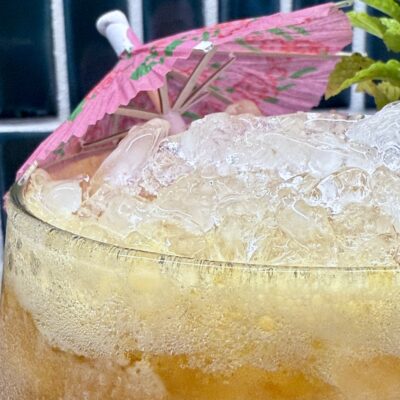
Frost adorns the Chartreuse Swizzle
A good friend of mine has been reading a collection of short stories by PG Wodenhouse about a character named Bertie Wooster and his valet, Jeeves. He came across a passage in the 1924 classic “The Rummy Affair of Old Biffy” in which Bertie recounts his experience at an exhibition at Wembley in North London. There, he is drawn to a Planter’s bar where a man is mixing an unusual West Indian cocktail. Without going into specific detail, he simply states that the drink contains seven ingredients:
“A planter, apparently, does not consider he has had a drink unless it contains at least seven ingredients, and I’m not saying, mind you, that he isn’t right. The man behind the bar told us the things were called Green Swizzles; and, if ever I marry and have a son, Green Swizzle Wooster is the name that
Take a bigger gulp of this article. . .
 So, maybe you never made the tonic, or perhaps limoncello isn’t your thing. Did you at least make simple syrup? Here’s a recipe for something that’s really easy. It’s a delicious ingredient for tropical cocktails that you can buy, but it’s hard to find and making it only takes minutes. Chances are, the flavor will be better and you’ll have fun doing it.
Falernum is an exotic rum-based liqueur from Barbados that is infused with flavors of lime and spices. The simplest recipe comes from Rick at Kaiser Penguin, but I added some toasted almonds to the mix. He breaks it down into two basic steps. First, you prepare the rum infusion that sits overnight. Then, you prepare a rich simple syrup. Strained and combined, your falernum is ready to use.
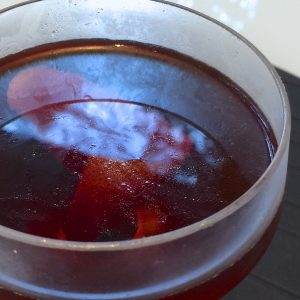
Falernum Infusion: 8 oz overproof rum (or any rum you like) 8 limes, zest only 50 cloves 1
Take a bigger gulp of this article. . .
 Making a great cocktail takes time, and if you have tried to recreate any of the recipes here, you know that the results are worth waiting for. But, during those moments when you have a guest waiting, you need a plan that makes the most of your equipment, your space, and your time. Although technique is important from beginning to end, I believe the biggest challenge comes when using fresh citrus.
It’s not that squeezing citrus is a big problem. It isn’t. In fact, if you aren’t using fresh juice in your cocktails it is by far the best improvement you can make. Yet, the moment you do start squeezing fruit, you quickly realize that the additional steps can slow you down, and if you are just a little bit clumsy, can result in a sticky mess all over the work area. Not everyone has the perfect space for making drinks, and few of us can dedicate an entire section of the kitchen for the task. With everyone probably doing it just a little bit differently, I thought I would write about my experience with some of the equipment I have used as well as a few techniques that make the process a little easier.
Juicing Equipment
Let’s get a few things out of the way first. Some gadgets are just impractical. First on the list are the little wedge squeezers. Most of them are made of thin, stamped metal. One is setup like a pliers that you hold in your hand to squeeze lime wedges. Another is shaped like a cute bird with a hinged tail that pours from the beak. When you make a sour, you need .75 to a full ounce, and you are not going to get that much juice from a wedge. Consequently, you’ll be squeezing wedge after wedge, juice spraying everywhere, while you try to collect enough juice. This is just a hassle, not to mention the fact that you need to cut everything into wedges in the first place. These may be fine for seafood, but not for cocktails.
On the opposite side of the spectrum are the big, heavy pull-arm squeezers. Setting aside their higher price, these are fantastic for juicing a lot of fruit. I own the Hamilton Beach Juicer which does a great job of extracting every last drop from grapefruit to key limes. If I batch my juice or want a gallon of fresh orange, I pull this out. Similar models may work just as well, but to be honest,
Click here and take a bigger gulp of this article →
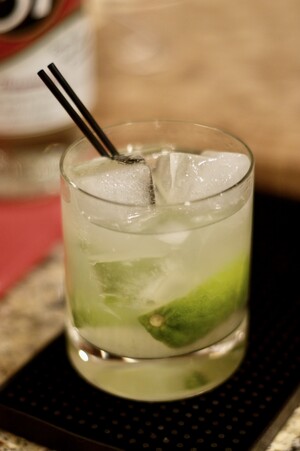
 There’s a good reason I am not referring to the Drink of the Week as a “Dark ‘n Stormy®”—I’m using “and” in my drink name because because the “n” version is a registered trademark owned by Gosling’s Brothers Limited, makers of Gosling’s Black Seal Rum. Gosling’s is made in Bermuda where the this is their official drink, but it’s actually popular throughout the British Commonwealth.
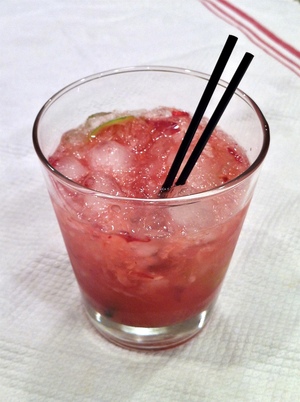
It’s certainly not a complicated drink by any stretch. The official version requires that you add 1.5 ounces of Gosling’s Black Seal rum to a tall glass of ice and top with their brand of ginger beer. Of course, there’s nothing wrong with doing that. Nothing wrong at all. In fact, this official recipe is both simple and delicious. Even if you can’t get your hands on Gosling’s brand of ginger beer, Reed’s is always available at Trader Joe’s, and I expect others would
Take a bigger gulp of this article. . .
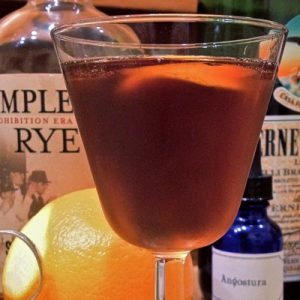
Supposedly, July 27th was National Scotch Day. I know it’s not the most popular holiday, but the timing was pretty good (it was a coincidence, really) for describing the Scotch tasting event last week and for featuring the Blood and Sand cocktail the week before. I thought about selecting another Scotch drink this week but I decided it was time to move on. That’s when a friend of mine finally tracked down some Cherry Heering and made the Blood and Sand. I wondered if perhaps there were other readers looking for additional ways to use cherry brandy, so I thought I would feature the Singapore Sling.
It can be a delicious cocktail, depending on the recipe you use. That said, it’s just as easy to make one taste awful. Part of the problem is that like a lot of cocktails, the original recipe was lost and this has caused
Take a bigger gulp of this article. . .
 This week I am featuring a cocktail that has been a long time coming and usually ranks as a favorite among cocktail enthusiasts. Actually, I posted the original recipe for this cocktail last year, but this version is a little more accessible. In fact, it includes one of the first homemade ingredients I ever made. Once you’ve whipped up a batch of special syrup, you can finally mix the Drink Of The Week, the delicious Mai Tai.
Trends come and go, and this was certainly the case with the Polynesian tiki craze of the 1950s. However, in the current mixolgy movement there is plenty of room for tropical cocktails, and with so many rums and other ingredients available, tiki culture is bigger than ever! And why shouldn’t it be? Tiki cocktails are among the most complex, most ambitious, and most flavorful concoctions out there. Multiple rums in one drink, unusual homemade syrups, fruit juices and exotic garnishes are all part of the game—but with all of these options both old and new, the Mai Tai is still the big kahuna.
Click here and take a bigger gulp of this article →
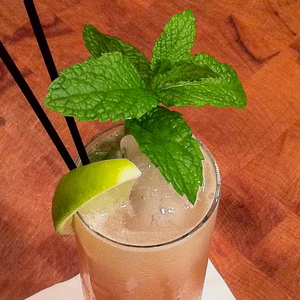
 About this time of year I start longing for the Gin Basil Smash, but my basil is just barely getting started. My mint, on the other hand, gets established quickly, and sometimes I even have some left over from Derby Day. What to do? Make the Southside cocktail! It’s a delicious summer drink that helps you forget about your basil for a while, and it’s perfect for warm weather.
The first thing you are going to notice, besides the fact that we are using fresh mint, is that this is another gin drink. By now, you should realize that a good share of classic cocktails, or at least a significant portion that come from the Prohibition era, are made with gin. That’s because gin was about the easiest spirit bootleggers could make—it is a basic maceration of botanicals and it requires no barrel aging. Some cocktails were created in
Take a bigger gulp of this article. . .
 It’s Cinco de Mayo, the voluntary holiday when we celebrate Mexican heritage. Although it’s virtually ignored throughout most of Mexico, the 5th of May is significant to folks in Puebla where the Mexican army defeated the French in 1862 against overwhelming odds. It was also the last battle in which a country in the Americas was invaded by an overseas army. The holiday has been celebrated in California every year since, and it has become nationally recognized in the United States as well as other countries, much like St. Patrick’s Day and Oktoberfest.
In recognition of this day and to pay tribute to our beloved spirit from Mexico, I am posting my favorite recipe for the most popular drink in America—the Margarita. The proportions of ingredients and sometimes the ingredients themselves are often debated. By most standard definitions, the Margarita contains tequila, triple sec and lime juice, but I
Take a bigger gulp of this article. . .
 The other day, the booze fairy delivered a bottle of Laird’s Applejack. Well, OK, it wasn’t actually the booze fairy, but rather a good friend “paying” me for some technology assistance. It happens that I occasionally do handy work and technology support for friends who sometimes see fit to compensate me this way. Am I complaining? Certainly not! So, this week’s Drink Of The Week is brought to you by the Technology Support Department at Summit Sips. We don’t advertise “Will Work For Booze” but it sometimes works out that way!
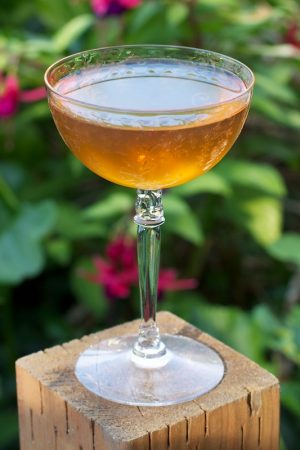
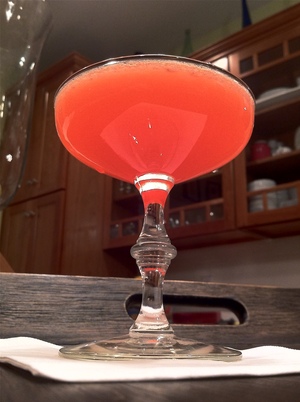
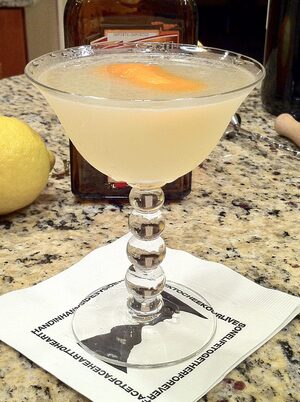
All of my recent posts regarding bourbon left me considering the fact that although it is truly an American spirit, it wasn’t actually the first to be produced in this country. That honor goes to Applejack, a brandy-based spirit produced from fermented apples. As one of our readers pointed out in a comment to my Kentucky Teaser, it was Laird & Company that obtained License #1 in 1780—our country’s first legal distiller. The Jack Rose cocktail pays tribute to this unique spirit. Classically portioned, this smallish cocktail can be made with either lemons or limes—both are delicious—and a few dashes of grenadine. There are many theories as to how this cocktail got its name, and you can entertain yourself with the research. However, I believe some things are often just as simple as they seem. It’s made with Applejack, and it’s rose-colored.
Click here and take a bigger gulp of this article →
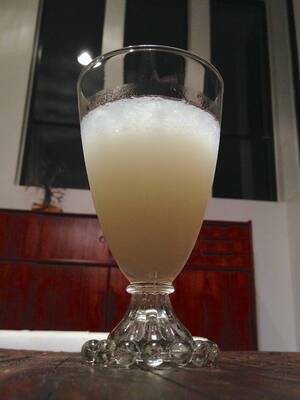
 Here we are with another exciting Drink Of The Week. It is exciting, right? This time it’s the Pisco Sour. Is it Peruvian? Is it Chilean? Who knows. It’s probably both. Get yourself some pisco and some limes, not lemons. Did you know that in Peru, what we call limes they call lemons? It’s confusing, but trust me, you should be using limes.
So, what’s pisco? That’s what you really wanna know. Pisco is made from distilled grapes including Quebranta, Muscat and Italiao varieties to create a kind of clear brandy. Depending on it’s origin and the type of grapes used, it can have a woody and sweet aroma and a flavor reminiscent of weak rum. Pisco and the Pisco Sour are the subject of an ongoing dispute between Peru and Chile. Each country claims to own the origin of the spirit and the popular cocktail. While the argument rages on,
Click here and take a bigger gulp of this article →
|
|
Most Popular