|
|
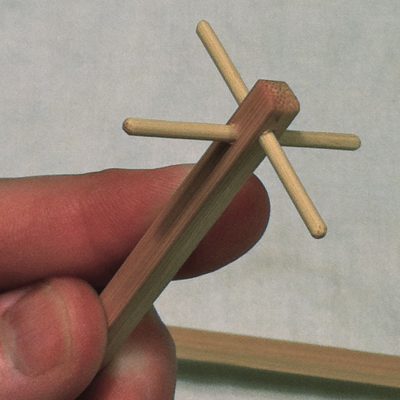
  Artist's rendering of the elusive "baton lele"
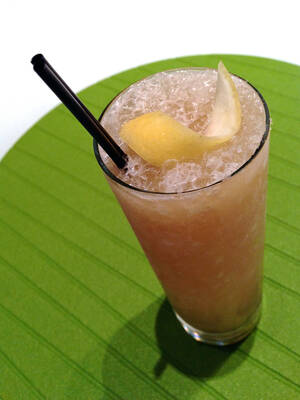
There’s a class of cocktails out there called the swizzle. They can contain any variety of ingredients but are often rum-based with a “Tiki” flair. A swizzle can be a Punch or something more akin to a Daiquiri, but they are served with crushed ice and usually find their origin in the Caribbean. What sets the swizzle apart from a Julep, for example, is the preparation. This is truly a cocktail-on-a-stick!
The Swizzle Method
I was a little skeptical at first, thinking that this is really just a primitive blender, but using the proper technique and the appropriate tool, it’s possible to get a nice coating of frost on your glass while you super-chill the contents. Basically, you dunk the spoked end of a stick into your iced cocktail and with the other end sticking up out of the glass, you rub it back and forth between your palms to carefully mix the ingredients. Once you get the hang of it, you can do this very quickly, steadily lifting up through the ice or pushing down toward the bottom. You can also mix just a specific layer in this way, avoiding chunks of fruit or muddled ingredients if the recipe calls for it.
Obtaining your own Swizzle Stick
The tool for this job isn’t just a simple plastic drink stirrer that most people associate with the term. This stick is cut from a tree that is native to the West Indies and is known for its unusual, five-pronged branches. With the Minnesota State Fair in full-swing, you might expect to find this stick for sale at the Merchandise Mart, or perhaps the Grandstand, but you won’t. Nor will you find one in the Horticulture Exchange or anywhere near Machinery Hill. In fact, you would be hard pressed to find a swizzle stick anywhere in St. Paul!
So, if you can’t buy one at the State Fair, surely you can find these exotic sticks online, right? Wrong. It seems the only way you can obtain an authentic swizzle stick is to get one from a good friend, fly to Martinique where they call it a baton lele and bring one back with you, or make one yourself. I love a challenge like that, so when I read Chris Stanley’s post regarding a DIY solution to this dilemma, I had to give it a shot. Not everyone likes such projects, and even though this is pretty simple, I decided to host a giveaway drawing (more about that later).
Click here and take a bigger gulp of this article →
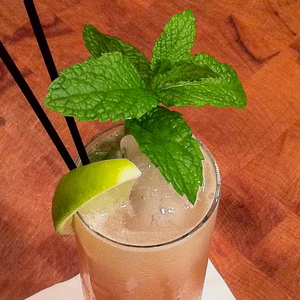
 This week’s Drink Of The Week is the Mint Julep. With Derby Day just around the corner and a spring that started early in the midwest, it’s time to get your mint in the ground. Even if it wont be ready by Sunday, there will be plenty of oppurtunity for you to use mint in cocktails this summer. In the mean time, pick up some fresh mint at the grocery store and I’ll show you how to make this delicious classic.
The Mint Julep is probably the oldest cocktail there is. Today, it’s a southern tradition that has been popular for centuries, and it’s also the official drink of the Kentucky Derby. That’s because the Julep we know is usually made with delicious Kentucky Bourbon, but it wasn’t always so.
Early accounts of the Julep represent this drink as a medicinal libation, or more specifically, a vehicle for its delivery. That’s not unusual as classics go, and neither is the evolution of the recipe. The word julep comes from the Persian, golab, which means rose water. There are early recipes based on gin and brandy with the first appearance in print in 1803 without a specific spirit mentioned. However, most of us today think of the Mint Julep as a bourbon cocktail, and that’s what I am sharing here:
Click here and take a bigger gulp of this article →
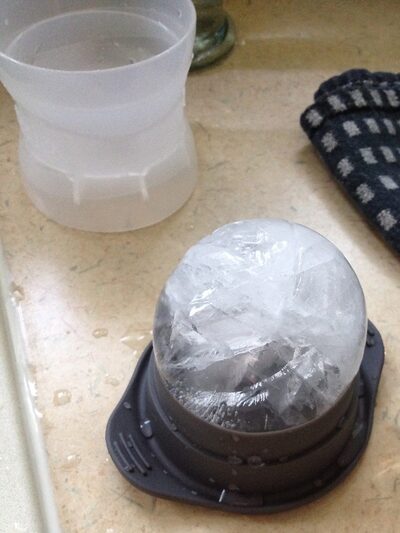
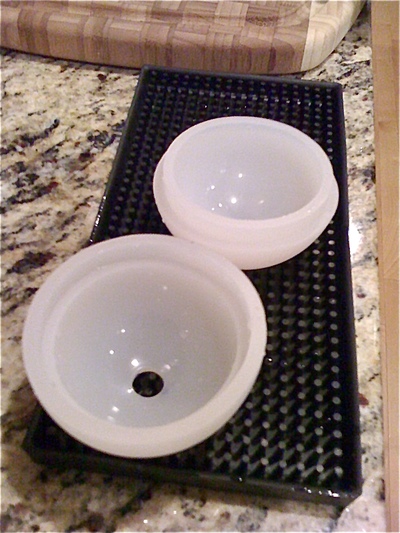
 A while back, I posted a lengthy description about How To Make Ice Spheres. If you recall, spheres of ice that fill your glass originated in Japan where they are hand-carved behind the bar. The large spheres keep drinks cold with very slow dilution. Not wanting to risk slicing a finger, I opted for alternatives to carving, but the best alternative is a very expensive ice melting device. So, I explored slow-molding options and until recently had settled on a two-part 3-sphere ice tray to pull this off. My tedious process often involved refreezing mis-shapen “eggs” in order to get the proper spherical aesthetic—until now!
Enter the Muji silicone Ice Ball mold. This unique and inexpensive mold does a fantastic job making spheres without the problems and hassles associated with a thin plastic tray. I was so happy to finally see these in stock at Muji online again that
Take a bigger gulp of this article. . .
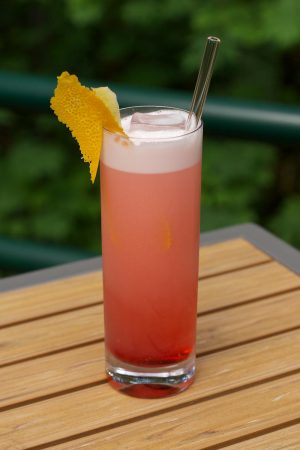
 Chimp In Orbit, huh? This ought to be good! I admit, it’s a really odd name for a drink. So, why monkeys in space?
This week in history. . .
I was researching this week in history and found a few things that seemed thematic to me, although not every story has a good ending. First, on this day in 1986, the Space Shuttle Challenger exploded. I know, it’s not a happy event, and it’s certainly not an image most of us will forget. So, let’s just get the sad stuff out of the way first. In the coming week on February 1, 2003, the world watched in shock and disbelief as the Space Shuttle Columbia broke apart on re-entry. Again, it’s another sad day for the space program. Meaning no disrespect to those brave spacefarers who lost their lives, there were a couple positive achievements that also occurred.
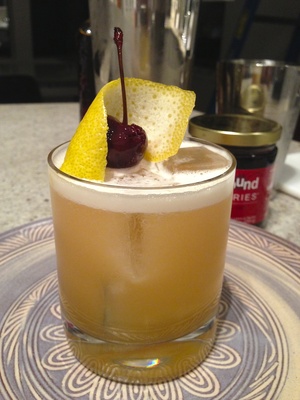
January 31st marks the anniversary of the 1971 Apollo 14 launch, the third mission to land men on the moon. This anniversary coincides with the launch in 1961 (here it comes) that sent a chimpanzee named Ham into space! Is it a crazy excuse to feature this drink? Well, that’s not all! In addition to the space references, the tropical nature of this cocktail is represented in history by the TV show, Fantasy Island which first aired on January 28, 1978. Finally, this day is also Elijah Wood’s birthday. I know, Frodo was a hobbit, not a chimp, but it’s close enough.
Ok, enough with the goofy historical references—let’s get to the drink.
Click here and take a bigger gulp of this article →
 For some people it’s a burden and for others it’s a joy—that time of the year when everyone is expected to exchange gifts. Whether or not you enjoy the holiday season there is one thing most of us agree upon: how frustrating it can be to try to come up with good gift ideas. Sure, there’s amazing and expensive technology out there with plenty of fun gadgets that will be obsolete by this time next year, but how about a more traditional approach? Why not give a gift that will inspire or will teach, or will assist? I’m talking about useful gifts for the mixologist in your family.
A Shopping List
I’ve written before about using good tools and technique with an emphasis on making the most of what you already own. That’s fine for the rest of the year, but this is the perfect time to consider items that can help elevate your mixologist’s skills and abilities so they (and you) can enjoy even better cocktails in the coming year. These suggestions are in no particular order, and some of the best resources for buying these items are listed at the end:
- Boston Shaker – It has to be the most useful tool for the home imbiber. The Boston Shaker is what almost every professional bartender uses to mix cocktails. It’s comprised of a large, 28 ounce metal tin and a 16 ounce pint glass. This simple tool will have your mixologist shaking in no time! They are easy to clean and usually very inexpensive. What’s that you say? They already have a 3-piece (cobbler style) cocktail shaker? Get them a Boston Shaker anyway—trust me—they will be glad you did. A 3-piece shaker might look convenient, but they are messy, they don’t seal (or don’t come apart!) and they are often just more clumsy than they need to be. Since the Boston Shaker is so cheap, you’ll want to add:
Click here and take a bigger gulp of this article →
 In a recent article, I described the importance of ice in your cocktail, describing the different kinds of ice you may want to use depending on what you are drinking. If you have ever visited the Bradstreet Crafthouse or a handful of other fine destinations, you may have marveled at the drinks that feature incredible spheres of ice—smooth glacial planetoids that literally span the entire width of the glass. Much more than mere aesthetics, these arctic wonders are functional, keeping their cocktails cold while minimizing dilution. That’s because a sphere has the smallest possible surface area for a given volume. Less surface area means less melt, and that results in longer sip time without loss of flavor or temperature.
So how does a bar create a 3-inch sphere of ice? The only answer, up until a couple of years ago was that they carved it! The ice sphere trend started in Japan amidst a mini-craze of whisky drinking. Japanese bar-goers wanted to slowly sip and enjoy their spirits (or maybe they took frequent breaks at the karaoke microphone). It had long been known that large chunks of ice last longer, so eventually someone decided to push that concept to the limit. I like to imagine it was a bright, young college kid majoring in physics or maybe working on a thesis in thermo-dynamics. I picture him as an undiscovered sculptor or perhaps a descendant in a long line of Samurai sword makers.
Method One: Carving
Here’s an amazing video featuring one such artist carving away at a chunk of ice until his sphere is just right. You can do this at home. You really can—if you don’t mind losing a finger or two! Actually, I understand that the process simply involves chopping away at a cube to remove the eight corners, then chopping at each of the 24 corners that result, and so on until it’s relatively smooth. But I don’t recommend this method. I am certain that if I tried this, aside from slicing into my hand, my sphere would come out looking like an ice bean, or a Shmoo. Besides, is this any way to treat your knives? There is an alternative, and it’s a lot easier, but. . .
Click here and take a bigger gulp of this article →
|
|
Most Popular